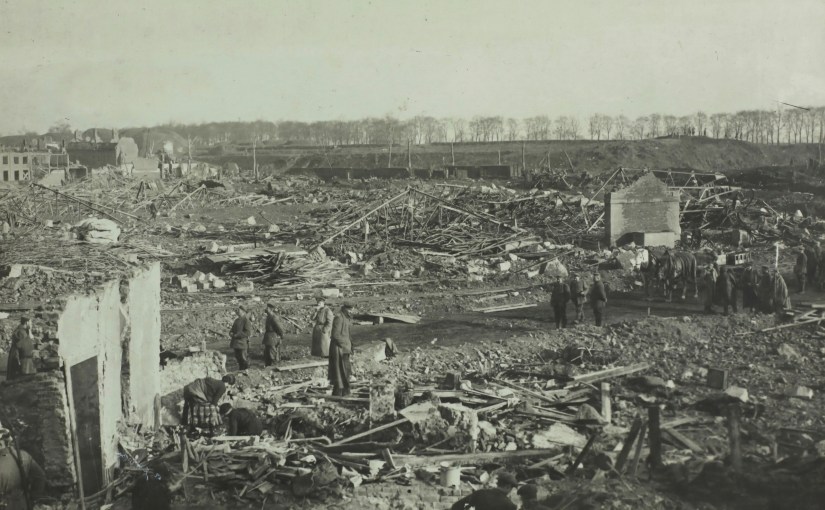
For nearly a century, Europe has managed to avoid the most resenting and repulsive element of human nature: war. At least on its own territory. Today, war, whether in its ideological and perhaps in its physical meaning, seems inevitable for the European union. How, socially and philosophically speaking, have we arrived at this point?
The last eighty years or so, the present and future in the West seemed relatively malleable and perfectible; in line with the time spirit, states were able to predict, shape and design their economies and social landscapes without much interference. In other words, the human condition seemed rational: one would not go to war as it would not be beneficial to economy and safety. All parties involved would be worse off, was the dominant notion, especially after WWII. Rationalism became the dominant philosophy: human decisions, from then on, would logically align with human self-preservation. Policies, law and social spheres became aligned with rationalism.
Humanity, from the rational perspective, would refrain from any act that could delay or harm its growth, including war on its own territory. Wars and conflicts were distant occurrences that happened in unstable countries far away from our safe haven. Particularly after the Cold War, optimism and rationalism were omnipresent in Western doctrines. Within the guarded confines of the EU and under the shield of NATO, safety was deemed self-evident. It rapidly became normalized. Springing from such rational optimism, economic ties with autocracies were strengthened and would guarantee mutual benefit and more importantly: peace. And as peace was considered guaranteed, armies were dismantled and strategic thinking was replaced by economic thinking.
Increasingly, wars were considered a foreign thing, a distant rumble in the middle east or Africa. Or a quick newsflash about Ukraine that would spoil our mood for a minute or two. Moreover, the mere idea of the experience of war has vanished from the European mind. Now, war is creeping closer every day. The ongoing war waged by Russia in Ukraine illustrates this stubborn notion very well.
These developments also changed the social and political attitude towards war, from palpable and frighteningly real, towards one of abstraction and denial. In the Western rationalistic view, mankind is simply not capable of such horror. In all its naive comfort, it has unlearned to be aware of dangers, as if its geopolitical amygdala has been shut off. Likewise, it appears that the (Western) European mind has developed a reflex that wants to bounce back into comfort whenever it can, hence the continuous pleas for peace talks, which are comfortable on the short term but strategically disastrous on the long term.
The current doctrine prefers maintaining a status quo if that leads to prolonged comfort. This stance can be supported by the fact that the Baltics act more assertively towards Russia although being geographically more vulnerable than the West: they have internalized the horrors of soviet occupation and therefore retained a healthy dose of awareness regarding hostility. The strategy remains to keep war an abstract, faraway thing, at all costs. Even if Russian rockets use European airspace to make Ukrainian casualties, the political strategy remains to deny the altered reality by not intervening.
Profiting of this status quo, repressive states are combining force and threatening Europe from the outside. An unforeseen effect of the rationalistic approach was tunnel vision: the naive idea that the rest of the world would share the Western view. The optimistic, rational and predictable course of events as depicted in Europe, biased and overlooked the gradual rise of populism and autocracy. And even if the indications of increasing danger presented itself, they were rejected by the strong belief in human rationality and the reflex to hide in safe comfort. There was barely anticipation of the dark, irrational side of the human condition: the power of disinformation and the temptation of ‘strong’ leaders who propose simple solutions to complex problems.
Only lately, European authorities and military leaders have recognized the external threats and appealed to their citizens for more vigilance and awareness. The populations’ first response to this outcry illustrates this very well: in Sweden, the possibility of a war has scared youths and children; the army was asked to apologize for upsetting them. But sooner or later, we need to go back to the trenches.
© Stefan Hoekstra/The Social Writer, 2024. Unauthorized use/and or duplication of this material without express and written permission from the site’s author and/or owner is strictly prohibited. Excerpts and links may be used, provided that full name and clear credit is given to Stefan Hoekstra and The Social Writer with appropriate and specific direction to the original content.
 The Social Writer