
Introduction
It’s a cold and drizzly afternoon when I’m making a casual stroll around the block with my mom’s dog. Through my hazy spectacles I scan the environment. I notice that the scenery of the neighborhood is rather Dutch; the yards of inhabitants are sharply separated from each other by wooden hurdles. Territories seem to be marked strictly. Every garden is personalized by different types of plants or decorations, like miniature windmills or small Buddha’s. Some of the yards have printed canvases hanging down the wall, depicting tropical shores of exotic lands. Sadly enough, some tarnished images of palm trees won’t improve the cheerless ambiance of today.
On the background, I observe an indistinguishable row of modest red brick apartments. Housing of this kind can be found all over the Netherlands. All homes have typically large windows, sometimes exposing the lives indoors. A young family can be seen, preparing for dinner. And further down the lane, a young man’s face is lit up brightly by the screen of his computer. He seems to be playing some sort of video game. And from certainly every second house’s windowsill, the dog and I are stared down by a drowsy cat.
Light rain is multiplying the bitter feelings of coldness on this quite unwelcoming day. The first part of the walk leads along a gritty building. It might be a large retirement home, or perhaps a block of serviced apartments. Then, the pathway leads towards a downtrodden field, ideal to play catch with the dog. I’ve been walking this route countless times already.
Over time, I started to notice something peculiar about this mysterious building. During every walk, there’s an elderly lady sitting in her living room, staring out of her large window into the distance. It’s a returning scene whenever I pass by. Whether it’s evening or afternoon, one could always expect her to be unaccompanied, sitting right there on the couch. Usually it’s quite a discomforting picture altogether. Especially on days like this, when the surroundings are pretty much shrouded in despair.
While the dog is far ahead and already chasing carelessly after some neighbourhood cats, the window of the lady appears. Feelings of curiosity take hold of me. Cheekily, I peek inside once again, but things are unchanged. She is still there, but doesn’t seem to notice me. Or she doesn’t bother, who will tell.
She must be somewhere around seventy. Her haircut is characteristically Dutch; well maintained and short. The humble living room is weakly lit by the glow of an antique lamp in the corner. As with other Dutch homes, her tiny front garden is sharply divided from others by wooden fences. In the living spaces surrounding the premises, I see people of a similar age. One level up, a bald man is reading a newspaper, right above the woman. It is evident that every inhabitant has an enormous amount of privacy. Upon hearing the dog’s impatient barking in the distance, I set off to the field, leaving the building behind.
Meanwhile in my mind, a train of thoughts comes into motion, resulting in some solicitous questions. What had happened to her family? Where are her friends or acquaintances? Perhaps she’d lost all loved ones and has been grieving ever since. But that’s all sheer unlikely.
Of a sudden (while throwing a big twig for the dog to catch), I come to a more appalling conclusion. That it may be more plausible that she actually has family and relatives, possibly lots of them. But they have, apart from an occasional Sunday visit, forgotten of her. She had become too much of a burden and been sent to this grim place to spend the final years of her life.
Whatever the specific reason for her solitude might be, she’s always alone. Whenever I pass by. In the morning, afternoon and evening. In the weekend and during holidays. Her joyless face is always apparent. More saddening; her striking case seems to be just the tip of the iceberg. Many other people may find themselves in situations of a similar kind. Citizens of all ages. The wealthy and the poor.
Worrying signals
Lately, a load of disturbing news came in from the Netherlands. And to keep it polite, it made my eyebrows wrinkle. It’s the kind of news that appeals to me greatly, for it is on an individual level. The level which, in essence, really matters. It touches me much more than the upteenth update about the everlasting brexit or another rhetoric tweet by Trump. The items in question generally state that in addition to the elderly, also young adults in the Netherlands are now suffering from severe loneliness. Added up, that’s pretty much our whole society. One report stated that to escape their isolation, youngsters seek for refuge by calling out desperately for help, using online platforms such as Twitter and Instagram. Yet as much the news engages me, as little it surprises me.
Already for several decades, severe loneliness amongst the elderly is a widespread problem in the Netherlands. Unsurprisingly, signals addressing similar issues arise from neighbouring countries too. So, except roughly middle aged citizens and children, loneliness is fiercely prevalent throughout multiple groups in Western societies. It seems to affect citizens from all layers of society. The ones for whom loneliness is dominating life, have told that they experience social exclusion. For them, the absence of contacts or community often results in an agonizing depression and an overall feeling of dismay.
The most alarming signs have emerged mostly in the past years towards the upper echelons of publicity, but the process wherein loneliness became an undeniable problem was already unfolding for years beforehand. Perhaps for fifty years already. Over time, loneliness became a symptom, or more precisely, an inextricable characteristic of our society. It became integrated into our capitalistic system. Therefore, what is being covered in news reports right now, barely surprises me. As a social worker and as a citizen.
Yet what does, is that loneliness and all of its dismantling consequences had been noticed so late by the involved institutions. How could it be, for goodness sake, that people in such an (acclaimed) wealthy and socially developed country like the Netherlands have to scream out for help? In what follows, I shall make an attempt on describing some of its main causes. To do so, I use my experiences of living in Russia as a counterweight. The interesting comparison with this ice cold and gigantic country will promise to give some heartwarming outcomes.
Scattered community
I have had the privilege to live in provincial Russia for a while. It was a privilege, but not specifically because of its breathtaking architecture or astounding wealthiness: less material wealth is the reason for many Dutch to make fun of former soviet countries. And that is slightly presumptive, since in the Netherlands, we have enough troubles ourselves, though masked by cultural blindness. The privilege I had living in Russia revolves more explicitly around unmissable emotional aspects, rather than a large home or expensive cars.
My small country is considered to be rather progressive and tolerant when described by foreigners. It is listed as ‘very high’ on the human development index. In Russia or Ukraine, I often get jealous looks when telling I’m from the Netherlands. If we could exchange passports, they’d be definitely up for it. Furthermore, the economy is seen as prosperous, with the Netherlands ranking relatively high on most global scales, ‘beating’ states like Switzerland, Singapore and Turkey.
Overall, the living conditions in the Netherlands are regarded as pleasant and comfortable. Even when annual happiness researches are conducted by the authorities, the outcomes are that Dutch citizens are ‘generally satisfied’ with their lives. (note: such results expose painfully precise the weaknesses of statistical surveys in order to understand the flaws of an entire society. They reveal a lot, yet they don’t reveal anything.)
Provincial Russia obviously proved to be totally different. Perhaps it’s even the last place where Westerners would search for human warmth. But living in a place that opposes my own culture in so many ways, stimulated me to shift perspectives on my home country the Netherlands.
As if igniting a torch in a dark cave, residing in Russia denuded quite some poignant social flaws in my home country. Amongst them; some of the causes (and solutions) for our loneliness. Whereas the Netherlands may have the favour of the larger audience when it comes to living comfortably and wealthily, a period of time spending with a Russian family unveiled more and more cracks and holes in the seemingly impregnable upsides of living in the Netherlands.
When I lived in a provincial city in the Ural region, I started to learn many crucial things. But not that much about the Russian as about the Dutch culture. Although Russia surely knows some flaws (which has to do with corruption and annexations), loneliness is, in my experience, not particularly one of them.
Firstly, because family bonds are much tighter. Privacy and personal space are not considered to be as important as they are in the West. Throughout the gross of Russians there’s a good reason for all this; survival. Life is tough, especially in mid sized industrial cities. And when things get tough, people stick together and help each other. It’s traceable far into Russia’s history.
Families fulfil psychological basic needs such as human closeness. Often, there is no possibility, other than to share a two bedroom apartment with four or more relatives. Next to these motives for sticking together, it’s also just connected to the Russian culture, which emphasizes the importance of unconditional family bonds.
Those unconditional family bonds are a noteworthy difference in comparison to the Dutch culture. Especially in practise. The frequency of gatherings of the Russian family appears generally higher from what I’ve seen. This also applies to the intimacy between parents and children after eighteen. And even to the deepness of friend’s connections. Due to the overall harshness of living in Russia, people simply need each other more.
Deserving friends
How different is it in the Dutch and Western culture, where people tend to rely more on large circles of ‘friends’ but still want their portion of personal space, demanding the best of both worlds. From a psychosocial perspective, this way is more challenging and thus more liable to failure. Quality friend contacts and deep connections are believed to be established chiefly by oneself. This uncriticized fixation on friend circles is even praised by some Dutch anti-loneliness movements, ironically bypassing the importance of family and community. Family support is simply forgotten, as it were. In the Netherlands it’s out of the question that friends are naturally and almost exclusively of enormous importance.
This mechanism requires excellent social skills. Ideally you would be an assertive person, socially active and capable of establishing quality friendships, partly replacing the need for reconciliation by family. The problem now becomes evident. What if you’re slightly an introvert, and a little shy? What if you are somehow unable to obtain a fulfilling group of ‘friends’ around you? Or, also poignant, when you don’t have the money to participate in social activities and are subsequently too ashamed to admit it?
Normally, a Russian in trouble -such as loneliness- would turn to his or her family in suchlike circumstances, to be resupplied by a feeling of community and closeness. But for many youngsters (and elderly) in the Netherlands it’s the preferred endeavour to be independent and self sustainable. To be able to handle life without needing others too much. It can, for some, be rather shameful to live or stay for a longer period at their parents house after the age of eighteen. But in fact, we always stay dependent on family ties up to a certain degree, functioning as a safety net for unconditional support. You might conclude that the independence ideal went a little out of hand.
I am independent!
I am painfully familiar with this independence-borne loneliness myself. For years I lived in a small studio, where I was deprived of human contact for most of the time. At most, I have seen my neighbours maybe three times in three years. We all lived in our own shell. The obligatory, formal greeting in the corridor formed the peak of our interaction.
A great deal of these years I felt depressed, but its cause was initially unclear. I considered myself to be rather independent and self sustainable, and I regularly attended an evening of drinking beer with friends. On Sundays I would pay visits to my mother. And, I considered myself to be an averagely social person. Whenever trying to explain depressive feelings, I wholeheartedly excluded the possibility of loneliness. Loneliness compelled my life, even without me being aware of it.
Nonetheless, something was nagging me, and I couldn’t get my head around it. When, some years later, I visited a Russian family for the first time, the puzzle pieces started to fall into place. There, in cold Russia, I experienced a communal warmth not often felt in the Netherlands. Witnessing the antithesis of loneliness uncovered that I was suffering from loneliness after all. Most of the foregoing years I had lacked human closeness. In the Netherlands, depression had struck me multiple times and it appeared to be always more or less connected to insufficient social interaction.
There appeared to be some additional downsides when relying solely on expansive circles of ‘friends’. Most friends are, in contrary to family, interchangeable. Only a fraction of them could be counted as valuable in times of need. On rare occasions, perhaps twice monthly, I would hang out with closer friends who I knew from childhood. But most other ‘friendships’ appeared and disappeared, depending on my own pace of development, interests and (re)location. For the most part, I gathered with acquaintances on Saturday evenings to have a beer. Likewise, the majority of my social life revolved around meetings of this superficial kind.
My social role on a peripheral level demanded much of me: to be energetic, funny and sharp all the time. Therefore, whenever I felt slightly unsociable, I started avoiding such gatherings. Paradoxically, avoiding these social activities pulled me down even deeper. Slowly I withdrew from most of them, and depression had swiftly taken hold of me. As a consequence, I also frequented my closer friends less regularly.
Even though family would be glad to host me for some while, I was too proud to admit that I failed in sustaining a circle of friends. That I failed to be independent. So I kept my mouth shut about it. I was too ashamed to admit that I was actually not that ‘independent’ as I would’ve liked to see myself. It went on like this for months. And these appeared to be the aspects on which loneliness thrives best.
There are -apart from some extreme cases- no excuses for families to abandon each other, or specific members. Although Dutch families are unlikely to be less loving or forgiving than their foreign counterparts, it is essential that this love and care is being practised more intensively in order to reduce loneliness. Unchallenged independence is a myth. Up to a certain point, we’re all dependent on each other, but the comatose state of comfort in the Netherlands has alienated us from this.
Russia showed me that grandmother, grandfather, child, father and mother are all interdependent. The mother takes care of the child, and later on, the child takes care of the mother, and so on. Not as a burden, but as an honour.
Independence may never overshoot towards neglectance. But I suppose that’s what had happened in the Netherlands over the last decades. Friends are of course, for lots of people, profoundly meaningful. But leaning exclusively on the emotional support of friends is walking a slippery slope, as friendships rotate from time to time. Often, friend connections are conditional, where most family bonds can expected to be unconditional.
Conclusively, it’s worth reminding that like in the Russian province, people are essentially and fundamentally reliant on each other’s help and support, acquired in whichever way. The entire human race is in fact one enormous community, but at the same time segregated by group dynamics, professions and status roles.
As Western societies aimed to produce more material wealth, social roles have dispersed towards required specific job positions and hierarchical statuses, fueling the increased separation. Yet for loneliness and social seclusion to diminish, one must look into the core of human existence. It’s of utmost importance that we are consistently reminded of the fact that we, as humans, are in core essence nothing more than overdeveloped apes: social animals, now yearning for the cohesive community as desired by our deep ancient cores.
Loneliness for profit
Under these personal and cultural obstacles, lies another tenacious issue. Namely, that nowadays the economy is seen as something divine. In a dogmatic way. Our tiny, swampy country is drenched in capitalism and economical ambition, often without its ethics being doubted. It would be too shallow to link loneliness to this mere fact, but it might be the driving force behind something closely related to loneliness; individualism. It’s the very notion that the individual rises above the group. And, if misused, that’s toxic for any kind of community.
Undoubtedly it is a pleasant idea to be able to become the individual you pursue to be. An entirely unique and autonomous person, distinguished clearly from the masses by clothing, philosophy, hobbies, values, beer brand preferences and so on. In this way, you’re separated from others. But alas, reality is less romantic.
Individualism is in favour of many companies who’d love to sell their stuff. Individualism and commerce go hand in hand. The more people are separated, the more revenue it will generate for companies. The more people pursue individualism instead of collective goals, the more they will spend on personalized items. It plausibly explains why every family member of an average middle class household owns or pursues to have his or her own car, television, jewelry or a closet filled with an abundance of expensive clothing.
More precise and strikingly, it’s even in economy’s favour when you’re lonely. Because you will purchase more products or services as a desperate attempt to compensate or end your fundamental sad state. Online dating platforms such as Tinder flourish on the increased separateness of people. It is in non of their moral concern to actually unite all people, for their business would then be lost. So from a mere moral perspective, the dismissal of Tinder should be their main endeavour. But of course, it isn’t.
Devouring tons of ice cream, while weeping on the couch to handle a break up is the classic example of this. As is overeating in general, actually. Similarly relevant; the lonely businessman who buys himself a second or third fancy car, or when one is omitting any human contact by ordering a specific pair of earrings on distant Chinese webshops. In a way, it’s all the outcome of loneliness.
Socially content and emotionally fulfilled people add less to economy, for they are not in need of (luxurious) goods to make up for emotional emptiness such as loneliness. Which, however, doesn’t mean they don’t buy anything at all. Sadly, nowadays’ unlimited possibilities to purchase any thing, only reminds us of the things we’re deprived of.
The loneliness as experienced today, seems to be merely a side effect of the way Western societies are intentionally organized. Ruling out loneliness is unfortunately not its main priority. It’s the mere collateral damage of capitalism as it is organized today. It’s indeed the high price we pay for overall material wealth.
Politicians and CEO’s perceive loneliness-borne depression mostly as just an another expense. Therefore, these statisticians only measure the revenue loss loneliness inflicts to their companies and economies and consequently free up some millions to lessen it. To them, lonely (and therefore unproductive) people are seen as ‘revenue loss’. Accordingly, they now also became a burden for society, next to being a burden for their family already. The severe pain an agony it creates on an individual level are often overlooked and underestimated by those who run the countries in question.
In part, the sticky fingers of the market economy can be averted, albeit on an individual level. The number of compensating services and products is enormous, but they will only move you further away from discovering the real problem. When you feel the sudden need to buy something expensive, question yourself where this desire comes from. Whichever void you are suffering of, it is barely of a materialistic kind. The same critical mindset might be useful when needing platforms such as Tinder. Are you genuinely interested in the displayed profiles, or are you just deprived of something in your daily life?
Social media: a maintaining factor.
In spite of their seemingly limitless possibilities, social media didn’t really enhance the amount of valuable social contacts. Instead of expanding it, our social contacts have simply been relocated to the online world. It seems implausible to me, that I would have less (or much more) friends if I were born in an offline world. The effort we would originally put into meeting new people in real life, has refocused on meeting new people online, for which less effort and less social skills are demanded. You simply press or swipe your screen, in order to get in touch.
Once established, we have borderless accessibility to our existing circle of friends. So borderless that stepping outside this circle has become unnecessary. Overcoming shyness or insecurity is not mandatory anymore, so people who are bound by these characteristics (including me) will have more difficulty creating new physical contacts. Therefore, social media have increased the connectivity with existing friends, but paradoxically decreased chances for making ‘new’ friends. People are increasingly stuck in their own bubble of friends. Or stuck in their bubble of loneliness. And escaping it is harder than ever before. In the case of already socially introvert people (like myself), social media are preserving loneliness stubbornly.
A prospective
The outcomes of loneliness are not to be underestimated, and have fargoing consequences for society: often it’s the most isolated people who (further) develop severe psychiatric disorders without supervision, causing psychosis and affect states in social situations, sometimes resulting in murder, rape and abuse. Close to my hometown the other day, a man filled his home with gas, eliciting an enormous explosion, killing himself and injuring others. He was a psychiatric patient, living in seclusion. As with ancient tribes, the feeling of being repulsed from the community induces an agony so painful that most of us can hardly bear with it. It’s why bullying or parental neglectance has such extreme effects on the shape of our personality.
On the frontline of the loneliness battlefield, small scale recreating of communal settings has already begun: on a charity level, cooking classes are organised for anyone interested, board game evenings are held for lonely elderly, and depressed youngsters seek each others proximity through buddy projects. Nonetheless, these are only emergency interventions; temporary field hospitals, set up after the striking epidemic of loneliness, wherein social medics are running to and fro to care for the abundance of ill patients. And mainly the less wealthy parts of this planet possess that vital cure, which we need so badly in the West: Community.
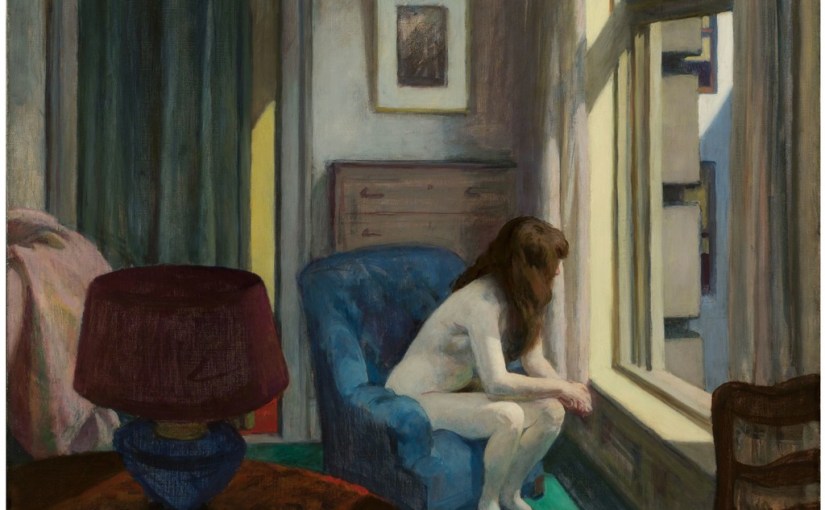
Header image: Eleven A.M., 1926 by Edward Hopper.
© Stefan Hoekstra/The Social Writer, 2020. Unauthorized use/and or duplication of this material without express and written permission from the site’s author and/or owner is strictly prohibited. Excerpts and links may be used, provided that full name and clear credit is given to Stefan Hoekstra and The Social Writer with appropriate and specific direction to the original content.


 The Social Writer