Back to The Trenches

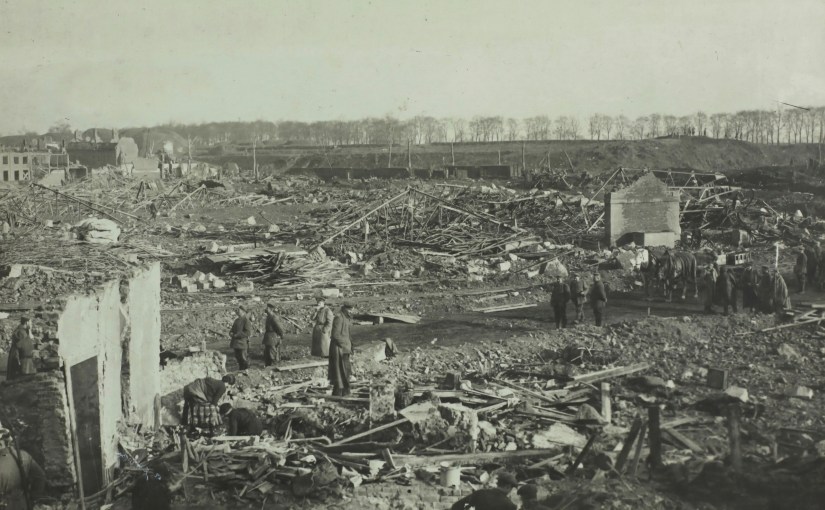
For nearly a century, Europe has managed to avoid the most resenting and repulsive element of human nature: war. At least on its own territory. Today, war, whether in its ideological and perhaps in its physical meaning, seems inevitable for the European union. How, socially and philosophically speaking, have we arrived at this point?

The last eighty years or so, the present and future in the West seemed relatively malleable and perfectible; in line with the time spirit, states were able to predict, shape and design their economies and social landscapes without much interference. In other words, the human condition seemed rational: one would not go to war as it would not be beneficial to economy and safety. All parties involved would be worse off, was the dominant notion, especially after WWII. Rationalism became the dominant philosophy: human decisions, from then on, would logically align with human self-preservation. Policies, law and social spheres became aligned with rationalism.

Humanity, from the rational perspective, would refrain from any act that could delay or harm its growth, including war on its own territory. Wars and conflicts were distant occurrences that happened in unstable countries far away from our safe haven. Particularly after the Cold War, optimism and rationalism were omnipresent in Western doctrines. Within the guarded confines of the EU and under the shield of NATO, safety was deemed self-evident. It rapidly became normalized. Springing from such rational optimism, economic ties with autocracies were strengthened and would guarantee mutual benefit and more importantly: peace. And as peace was considered guaranteed, armies were dismantled and strategic thinking was replaced by economic thinking.

Increasingly, wars were considered a foreign thing, a distant rumble in the middle east or Africa. Or a quick newsflash about Ukraine that would spoil our mood for a minute or two. Moreover, the mere idea of the experience of war has vanished from the European mind. Now, war is creeping closer every day. The ongoing war waged by Russia in Ukraine illustrates this stubborn notion very well.

These developments also changed the social and political attitude towards war, from palpable and frighteningly real, towards one of abstraction and denial. In the Western rationalistic view, mankind is simply not capable of such horror. In all its naive comfort, it has unlearned to be aware of dangers, as if its geopolitical amygdala has been shut off. Likewise, it appears that the (Western) European mind has developed a reflex that wants to bounce back into comfort whenever it can, hence the continuous pleas for peace talks, which are comfortable on the short term but strategically disastrous on the long term.

The current doctrine prefers maintaining a status quo if that leads to prolonged comfort. This stance can be supported by the fact that the Baltics act more assertively towards Russia although being geographically more vulnerable than the West: they have internalized the horrors of soviet occupation and therefore retained a healthy dose of awareness regarding hostility. The strategy remains to keep war an abstract, faraway thing, at all costs. Even if Russian rockets use European airspace to make Ukrainian casualties, the political strategy remains to deny the altered reality by not intervening.

Profiting of this status quo, repressive states are combining force and threatening Europe from the outside. An unforeseen effect of the rationalistic approach was tunnel vision: the naive idea that the rest of the world would share the Western view. The optimistic, rational and predictable course of events as depicted in Europe, biased and overlooked the gradual rise of populism and autocracy. And even if the indications of increasing danger presented itself, they were rejected by the strong belief in human rationality and the reflex to hide in safe comfort. There was barely anticipation of the dark, irrational side of the human condition: the power of disinformation and the temptation of ‘strong’ leaders who propose simple solutions to complex problems.

Only lately, European authorities and military leaders have recognized the external threats and appealed to their citizens for more vigilance and awareness. The populations’ first response to this outcry illustrates this very well: in Sweden, the possibility of a war has scared youths and children; the army was asked to apologize for upsetting them. But sooner or later, we need to go back to the trenches.

© Stefan Hoekstra/The Social Writer, 2024. Unauthorized use/and or duplication of this material without express and written permission from the site’s author and/or owner is strictly prohibited. Excerpts and links may be used, provided that full name and clear credit is given to Stefan Hoekstra and The Social Writer with appropriate and specific direction to the original content. 
International State Terror

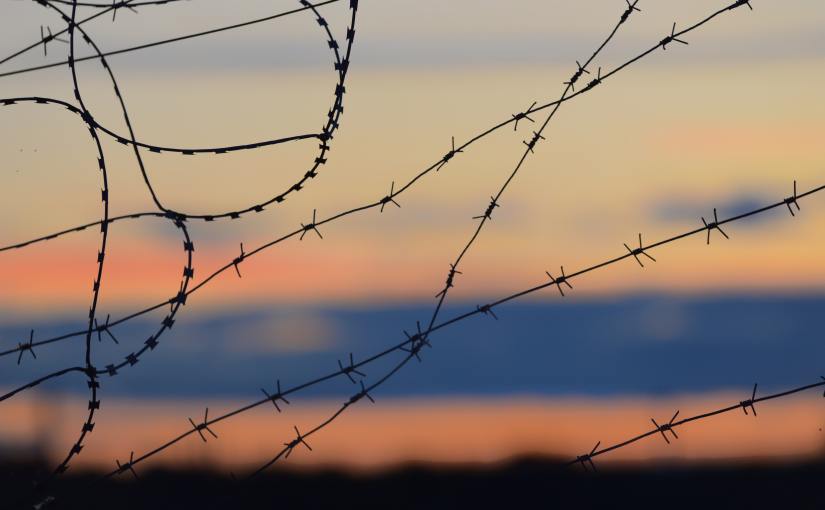
In his outstanding work The Rebel, Albert Camus came up with two concepts in regard to what he called ‘state terror’. Roughly paraphrasing him and others, I will draw some parallels with the ongoing war in Ukraine. In this light, Camus spoke of two forms of state terror in which revolutionary thought could overshoot, namely: rational and irrational state terror. The first, rational terror, will be elaborated on thoroughly in relation to the logic Russia is currently subject to. Helped by these concepts, this piece will argue why the war won’t end anytime soon and why it should be taken seriously.

States that apply terror, feel the need to sacrifice concrete, palpable life in order to create totality and fulfill an oblique destiny. In other words, they need to suppress and kill for a supposed greater good; a greater good that is far from certain. Irrational state terror, according to Camus, is what has been practiced by Nazi-Germany. What makes it irrational, is that its logic inevitably led to its own destruction. Taking the idea of movement and action to religious spheres after Nietzsche’s death of god, Nazi-Germany had set out on a crash course with the rest of the world in order to justify its existence; it always needed an enemy. It didn’t exist without war. For the first time in history, a state showed that it can create terror on an industrial scale.

Now, rational state terror, in relation to today’s Russia, finds its origins in the Soviet Union, in Lenin’s selective adaptation of Marx’ works. Lenin had rewritten socialist thought in a way that it would justify repression and suffering in the name of inevitable history. He claimed that an authoritarian regime would realize the predetermined lot of his union faster than simply waiting for it. He promised that at the end, when all is unity, the regime would be superfluous and dissolve itself. But no end date was given. Whether Putin’s Russia can be labelled as rational or irrational state terror, remains unclear until the final outcome of the war. Possibly it’s a mixture of the two.

According to Camus, an important component of rational state terror is the way it fabricates and manipulates truth -retroactively- in order to make all its actions seem rational as a logical means to an end. This mechanism is well illustrated in the works of George Orwell, like 1984, where newspapers are adjusted every second to match the changing reality and make it seem like the state is seamlessly following its own history. Unlike Nazi-Germany, which tried to hide its atrocities and horrors from the public and hypocritically pour out its violence over Europe, the Soviet Union presented repression as a necessary sacrifice: to achieve peace for all in an undetermined future, violence is justified in the present.

The state, in this case, wouldn’t even portray its violence as repression; merely as re-education to create totality and unity; a small detour along the Uighur camps in China. They would even take it a step further and claim that it is the unity of the state itself who is repressed by citizens who explicate deviant ideas. In a rational state, there cannot be any defiance, for all is totality: the future, the past and the present. Other perspectives that may distort this total image, must be either converted or destroyed without the possibility of martyrdom, which rhymes with the crusades in Europe’s dark ages.

This brings us to the terror in Ukraine. Why did Russia’s internal repression became external and spill over into Ukraine and previously Georgia, Chechnya and again, Ukraine? Above the much discussed strategic reasons for an invasion, Russia follows a certain logic, reminiscent of the Soviet constructs as described by Camus and others. In regard to the ‘deviant perspectives’ to the endeavored totality, Russia’s interference with Chechnya is interesting to begin with. When Chechnya revolted and tried to untie itself from the federation, its rebellion was smashed down by the freshly chosen president Putin. The goal: restoring totality. But the mechanism goes international, too.

The Kremlin’s knowledge of different perspectives, thriving in neighboring countries, creates eternal friction (which boasts nationalism and the need for a ‘strong leader’). Military or not, a state that pursues total unity exists in a perpetual state of war with opposing views, in Europe, Ukraine or elsewhere. A totalitarian state that has given itself the religious task of fulfilling human destiny, experiences continuous dissonance with neighboring democratic countries and is constantly reminded that its totality is unfulfilled. So the moment Ukraine moved into a more democratic direction, Russia’s latent dissonance accumulated into terror. Random attacks on civil targets might not just be a military tactic, it’s also a way of terrorizing and spreading fear, until Ukraine’s citizens will follow suit again and comply. If they refuse, destruction is what awaits them, to restore the totalitarian equilibrium.

The collision between democratic and totalitarian systems is denuded by the mere description of a democratic system. Democracies, respecting various perspectives, admit that there is always an area of tension, of conflict between visions. But contrary to other systems, the democratic one perceives conflict -in the form of dialogue and debate- as its main advantage. And historical dialectics, but also pure logic, have shown that the immense human diversity cannot be squeezed into one or two simple state models. Democracy offers a platform for the diversity to come to consensus and do more justice to the vast human complexity. Law and shared values, based on mutual decisions, offer an overarching foundation that bridges the gaps of a multiform society. In more Nietzschean terms: chaos brings order.

Conclusively, this is simply a description of the logic a state can follow, and whence it can lead to the application of terror. And if the question is posed whether Russia is applying terror in Ukraine, the answer following Camus’ paradigm is a full yes. Nonetheless, lacking the military power to create the world it adores, those in the Kremlin have learnt from the past, and have refined their strategies into quite sophisticated methods of manipulating public opinion and blackmailing their perceived enemies. Yet, the force of action and movement, in order for such a state to justify its existence, is only stopped when it collides with another force. Until that moment, the day that it is halted, the 21st century Red Army will roll onward.

© Stefan Hoekstra/The Social Writer, 2022. Unauthorized use/and or duplication of this material without express and written permission from the site’s author and/or owner is strictly prohibited. Excerpts and links may be used, provided that full name and clear credit is given to Stefan Hoekstra and The Social Writer with appropriate and specific direction to the original content. 
Deadly Relativism

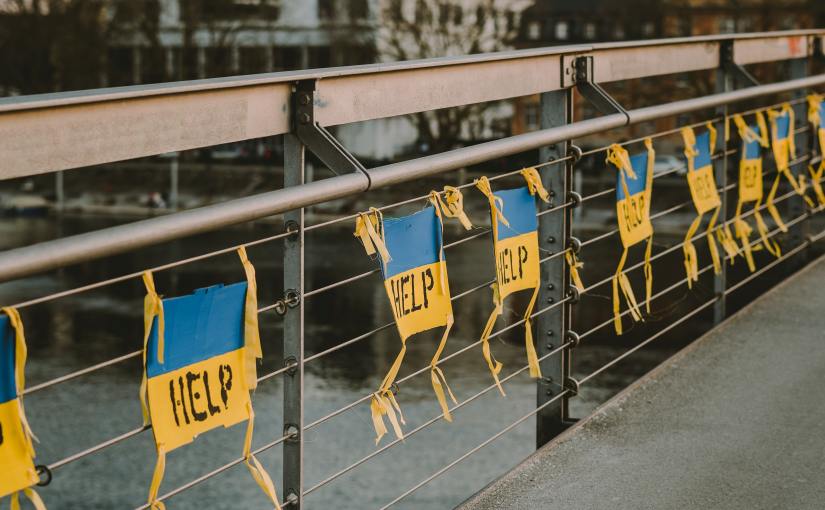
Nearly two weeks after Russia’s devastating invasion in Ukraine, a curious phenomenon is unfolding: Gradually but surely, Western folks seem to habituate with the increasing human suffering and bloodshed just outside the EU’s doorstep. Intervals between news updates become longer, terraces are filling up with smiling and chatting people, while just across the EU borders, Ukrainian children die of dehydration and hunger and civilians are tormented. The initial solidarity that was expressed by fellow Europeans is -wholly according to contemporary tenets- on the verge of becoming cynical. Upon seeing another bombed building we give a misanthropic sigh, turn away our heads, remark that ‘the world is rotten’ and return to our safe bubble of denial. Not only citizens explicate this attitude. Also NATO, the most powerful military alliance to date, has taken such a powerless stance.

The inclination to respond cynical to peril possibly serves as self protection, as is the tendency to compare incomparable conflicts to prove hypocrisy. General tendencies are to mirror the media attention to the Ukraine conflict to the one in Palestine, or cry that the US also invaded Iraq in 2003, and therefore loses its right to condemn Russia. In all these exclamations there might be a proportion of truth, but by now, there are no states left with a clear conscience. And instead of diminishing the ongoing misery, this relativism works counterproductive and merely paves the way to indifference. And it is exactly indifference that is in the advantage of the the world’s shift towards authoritarian totalitarianism; instead of becoming rebellious, we lean towards its opposite.

Underlying this lethargic indifference sits a certain nihilism. A dangerous belief that good and evil are no different from each other. That all is forlorn, all is chaos. Everyone is wrong, and everyone is right, depending the perspective. Perhaps it was the omnipresent safety in Europe, that made its citizens insensitive towards their own ideals and values; ironically the very basis on which its cherished safety is founded. Because if we zoom in at the state of Ukraine, we see a country that is attempting to escape the cynicism that dominates former USSR countries. A nation that is willing to leave behind its past and embrace democracy, displaying a militancy the EU can only hope for. The bravery of Ukraine against this ruthless aggressor reminds Europe of its own forgotten fundamentals, that’s why Ukraine could also count on widespread sympathy. They have what we lack. A sympathy, which is on the edge of turning cynical because of crooked comparisons to earlier wars, mostly to the self serving goals of the ones who make them.

Yet in the modern world, which is constituted by a dynamic of contradictions (Marshall Berman), hypocrisy is never far away and does not suffice as an argument for an empty nihilism. One who claims to never have been hypocrite, is hypocrite. Preceding unfairness likewise, does not legitimize new unfairness. If Europe still contains ideals indeed, hypocrisy must be subordinated to our norms and values, otherwise our existence will soon be illegitimate. A Europe like that, dissolving in relativism, will be food for the mouth of indifference, cynicism; for gloomy regimes like Russia’s. It needs to formulate its values well and defend them like Ukraine does for us now.

© Stefan Hoekstra/The Social Writer, 2022. Unauthorized use/and or duplication of this material without express and written permission from the site’s author and/or owner is strictly prohibited. Excerpts and links may be used, provided that full name and clear credit is given to Stefan Hoekstra and The Social Writer with appropriate and specific direction to the original content. 

Photo credit: Benjamin Marder.